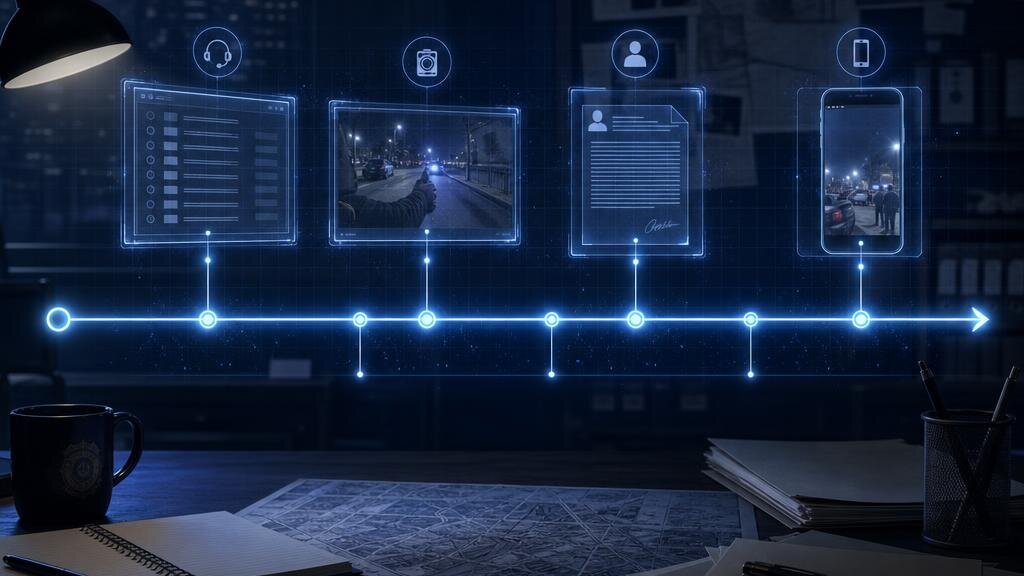
At 6:42 p.m., patrol responds to a disturbance call. At 6:47, dispatch updates the location. At 6:55, body camera starts recording after the officer exits the vehicle. At 7:03, a witness sends cellphone video to a detective. Two days later, someone writes a report from memory and gets one time wrong by eight minutes.
That eight-minute gap looks minor until a prosecutor is laying out the sequence, defense counsel is pointing to inconsistent records, and a supervisor is asking a question that should be easy, what happened first?
Case timelines are not glamorous. Nobody gets into law enforcement because they love chronology. But timelines do a lot of quiet work. They help investigators spot gaps, help supervisors review cases faster, help prosecutors prepare cleaner filings, and help agencies stand behind their work when every minute starts to matter.
And bad timelines create some very real problems. Not dramatic movie problems. Ordinary ones. The kind caused by copy-pasted notes, mislabeled uploads, drifting camera clocks, and three people all using different versions of the original incident time.
Why timelines matter more than people think
A good timeline is more than a list of timestamps. It is the working theory of the case, in time order. When it is accurate, it helps everyone. When it is sloppy, it spreads confusion through the whole file.
Investigators use timelines to test witness statements against physical evidence. If a witness says they heard yelling before a vehicle left the scene, but nearby camera footage shows the vehicle leaving several minutes earlier, that does not automatically mean the witness is lying. It means the sequence needs a closer look. Memory is messy. Time anchors help sort out what is simple recall error and what may be a meaningful inconsistency.
Supervisors rely on timelines for review. They do not always have time to read every attachment in detail before deciding on follow-up, clearance, or referral. A clear timeline gives them a fast way to understand what happened, what has been verified, and what still needs work.
Prosecutors care for obvious reasons. A case with a clean chronology is easier to charge, easier to explain, and easier to defend. If your report, CAD notes, evidence logs, and video timestamps line up, the case starts on much firmer ground.
Then there is public accountability. When an agency gets a records request, an internal review, or outside scrutiny, timeline issues tend to surface fast. Not because people expect perfection, but because chronology is one of the first things anyone checks when trying to understand an incident.
Here is the simple truth: if your timeline is unclear, people start questioning everything around it, including facts that may actually be solid.
How case timelines go sideways
Most timeline failures are boring in origin and expensive in effect. They usually come from ordinary workflow friction, not dramatic misconduct.
One common problem is duplicate entry. Dispatch has one time. The officer writes another in the narrative. A detective later summarizes both and picks the wrong one. Now the file contains three versions of the same event, and nobody is fully sure which one came from the original source.
Another problem is disconnected systems. CAD, RMS, evidence management, interview notes, and digital evidence tools may all store times differently. Some capture the time something happened. Others capture when it was uploaded, tagged, or reviewed. Those are not the same thing, but they often get treated like they are.
Body-worn camera footage creates its own brand of confusion. The camera may start after the officer is already on scene. The system clock may be correct, or slightly off. A clip may be labeled by upload time instead of event time. If nobody clarifies that difference, a reviewer can make the wrong assumption in seconds.
Witness statements add another wrinkle. People rarely remember exact times unless they checked a phone, saw a clock, or tied the event to something specific. Many reports quietly convert rough estimates into exact-looking entries. Around 8-ish becomes 2000 hours, and suddenly the file reads with more confidence than the source ever supported.
Then there is the classic cut-and-paste issue. Every agency has seen it. A report gets duplicated as a starting point. Most details are updated. One small timestamp is not. Months later, during a hearing, someone notices that the supplemental report places a detective at two scenes at the same time. Nobody meant to create a contradiction. It still became one.
If this sounds familiar, that is because timelines are where small administrative habits turn into evidentiary problems.
The difference between event time and record time
This is one of the most useful distinctions an agency can teach. Event time is when something actually happened. Record time is when someone documented, uploaded, or entered it into a system.
Those can be close together. They can also be hours apart.
For example, a witness texts a video to an investigator at 10:15 p.m. The video itself was recorded at 9:52 p.m. The evidence system logs it at 10:31 p.m. If your case summary treats all three as interchangeable, you are inviting confusion. A good timeline notes the difference clearly.
That sounds basic, but it prevents a lot of avoidable headaches.
What better looks like in a real agency workflow
A useful timeline is not just complete. It is readable, sourced, and honest about uncertainty. It should help a detective work the case, a supervisor review it, and a prosecutor explain it without making everyone dig through six systems to figure out what happened.
Start with source clarity. Each timeline entry should point back to where the information came from, CAD, officer observation, witness statement, body camera, surveillance footage, phone extraction, or evidence log. That does two things. It builds confidence, and it shows where to go if something needs to be checked.
Next, mark uncertainty on purpose. If the time is estimated, say so. If a witness said between 9 and 9:15, do not convert that into an exact timestamp unless there is independent support for doing it. Precision helps only when it is real.
Agencies also benefit from standardizing a few basic rules across units. They do not need a long policy manual to get better results. They need shared habits.
- Use one standard date and time format across reports and summaries.
- Separate event time from entry time when both matter.
- Note the source for each key event so reviewers can verify it quickly.
- Flag estimated times clearly instead of letting them look exact.
- Update the timeline as evidence develops rather than treating it like a one-time task.
The agencies that do this well usually are not doing anything flashy. They are reducing rework. They are making it easier for the next person in the chain to understand the case without guessing.
And yes, technology helps. Searchable records, linked evidence, auto-captured timestamps, and side-by-side views of reports and media can cut down on avoidable errors. But software does not fix unclear thinking. A system can organize timestamps. It cannot decide whether a timestamp reflects the event, the upload, or an officer's best estimate. People still need to make that call.
There is also a practical morale benefit here. Clean timelines reduce the back-and-forth that frustrates everyone. Fewer emails asking which time is correct. Fewer last-minute scrambles before court. Fewer meetings where five people debate whether a discrepancy is meaningful or just bad documentation. Good chronology saves time because it cuts down on re-explaining.
One more point worth making. A timeline is not just for major cases. It matters in everyday incidents too. The smaller the case, the more likely someone assumes the details can be stitched together later. Sometimes they can. Sometimes later is when the witness recants, the video disappears, or the complaint comes in.
That is why good agencies treat timeline discipline as a routine skill, not a special project.
The takeaway is simple: build timelines early, tie every key event to a source, and be honest about what is exact versus estimated. You do not need a perfect case file on day one. You do need a chronology people can trust. That one habit prevents a surprising number of problems before they become someone else's emergency.
Timelines that build themselves from the evidence
See how ShieldView reconstructs case chronology from reports, media, and evidence — with every event tied back to its source.